You'll need: A running wash plant (the trommel every site starts with, or a demo plant).
Every wash plant in Dirt Digger finishes the job on a riffled sluice: a sloped box of riffles with water running down it. The gold comes off the dirt at the head and travels down the run, and each time it crosses a riffle, the riffle keeps a share of it. How big a share depends on three things you control, and on the size of the gold. This guide explains them, then goes plant by plant.
The four rules, if you read nothing else:
- Water first, always. A sluice wants about 8 parts water to 1 part dirt, and its full flow. Short of either, the riffles scour and the fine gold rides straight out the tail.
- Don't drown it in dirt. More feed is not more gold. A sluice fed twice too fast keeps under a quarter of the fine gold instead of over half. A hopper heaped to the bars throws feed away, gold and all.
- Clean out often. Riffles fill with black sand and hold less as they fill. Cleaning costs you a minute and nothing else: the 1.5% lost in panning is the same however often you do it.
- Re-run your tailings. Even a plant run perfectly sends almost half the fine gold out with the tailings. It's really in that ground. Wash it again.
How a sluice catches gold
Gold comes in three sizes
- Nuggets (a gram and up) stop behind the first few riffles. You'll almost never lose them.
- Coarse gold, the bulk of the dust: a sluice run right holds about 99% of it.
- Fine gold is the hard part. Even run perfectly, a riffled sluice holds only about 55% of it, and it's the first thing you lose when anything is wrong. The ground lays down roughly a third of its dust as fine gold, and more of it where the creek has carried the gold a long way.
The three things you control
- Water against dirt. Full catch at 8 litres of water to each litre of dirt going down the sluice. At 5 to 1 the catch is down by half; at 2 to 1 the riffles catch nothing at all.
- Full water flow. Below about 83% of the flow the sluice is built for (a pump too far above its water, an engine below full revs), the catch falls with it.
- Riffle load. Black sand settles behind the riffles with the gold. As they fill they hold less: half full, about 58% of the clean catch; packed full, 15%.
| Run like this | Fine gold held | Coarse gold held |
|---|---|---|
| Run right | 55% | 99% |
| Riffles half full | 37% | 94% |
| Fed 60% too fast (5:1) | 33% | 91% |
| Fed twice too fast (4:1) | 23% | 80% |
| Pump at half flow | 15% | 61% |
| Riffles packed full | 11% | 51% |
These are shares of the gold reaching the sluice that stay in the riffles. Mistakes stack: overfed and riffles half full, a sluice keeps about a fifth of the fine gold and three quarters of the coarse.
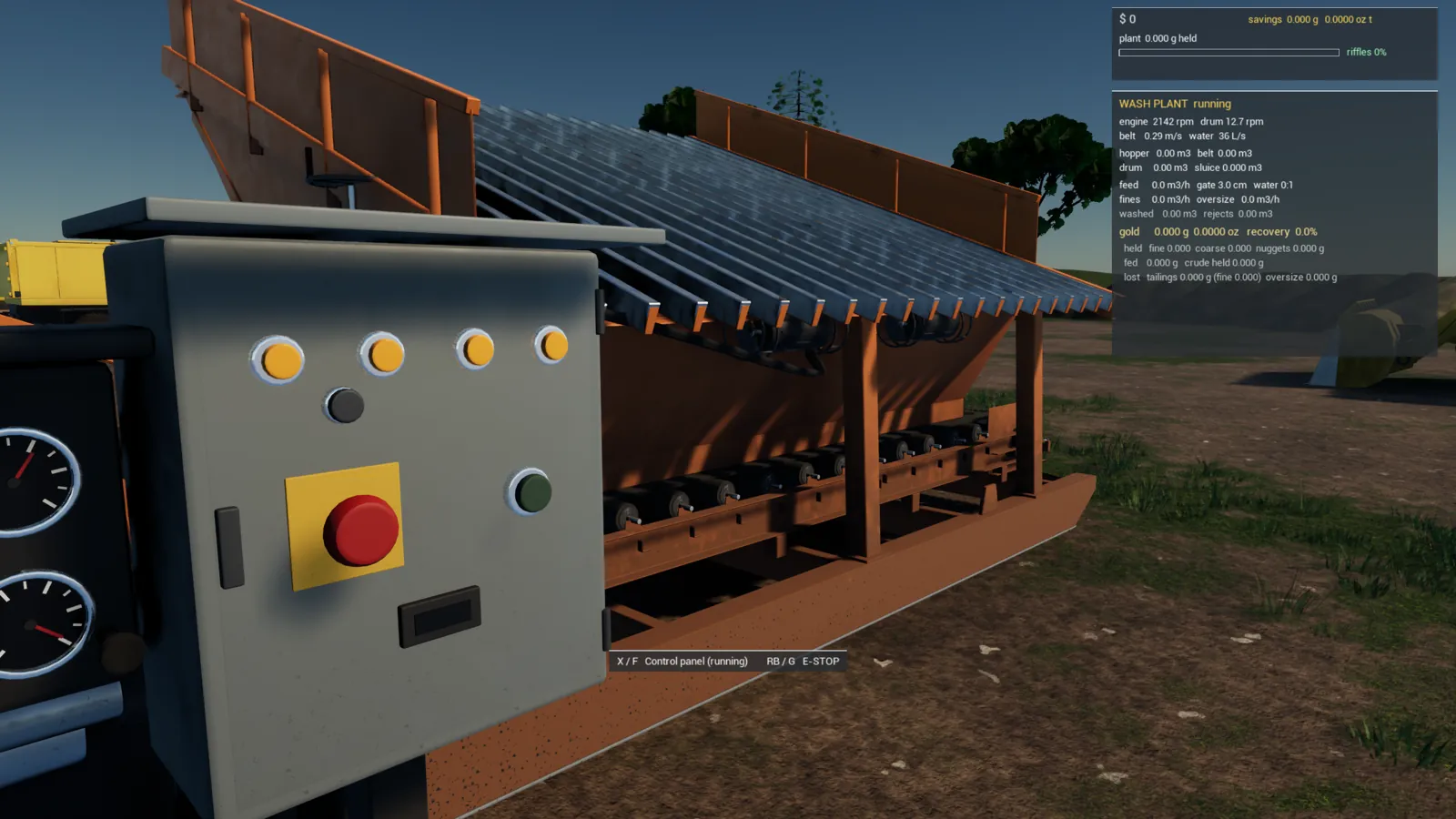
The 5 x 15 ft trommel wash plant
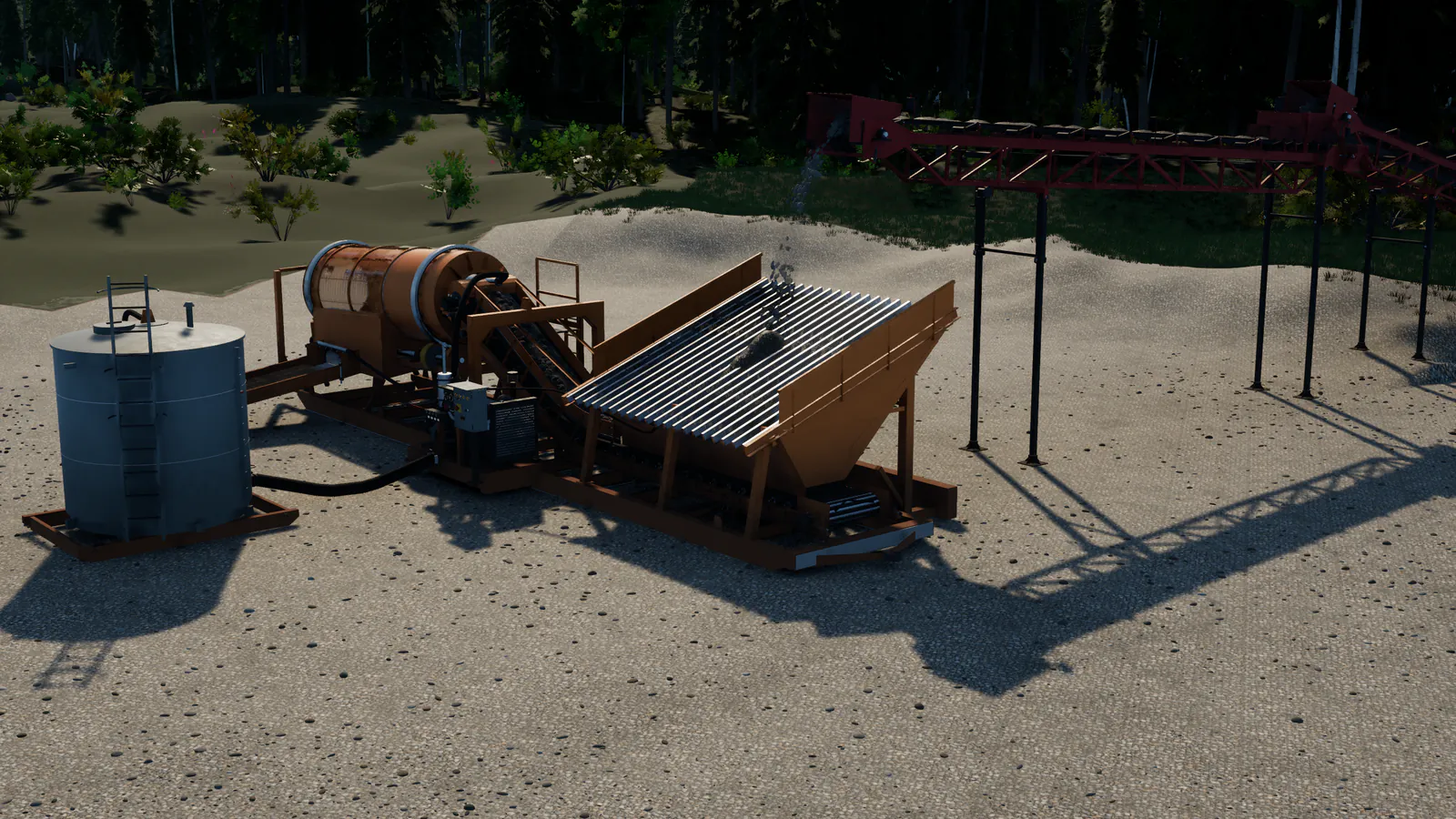
The camp's plant. It feeds about 46 m³ of gravel an hour, its pump gives 95 l/s off the engine, and its sluice is 1.2 x 3.2 m with 29 riffles.
- Water tank within 15 m, standing level. The tank's outlet must be within 15 m of the plant's suction inlet, and the tank tilted no more than 10 degrees. Out of reach, the plant shuts itself down and the board says NO WATER.
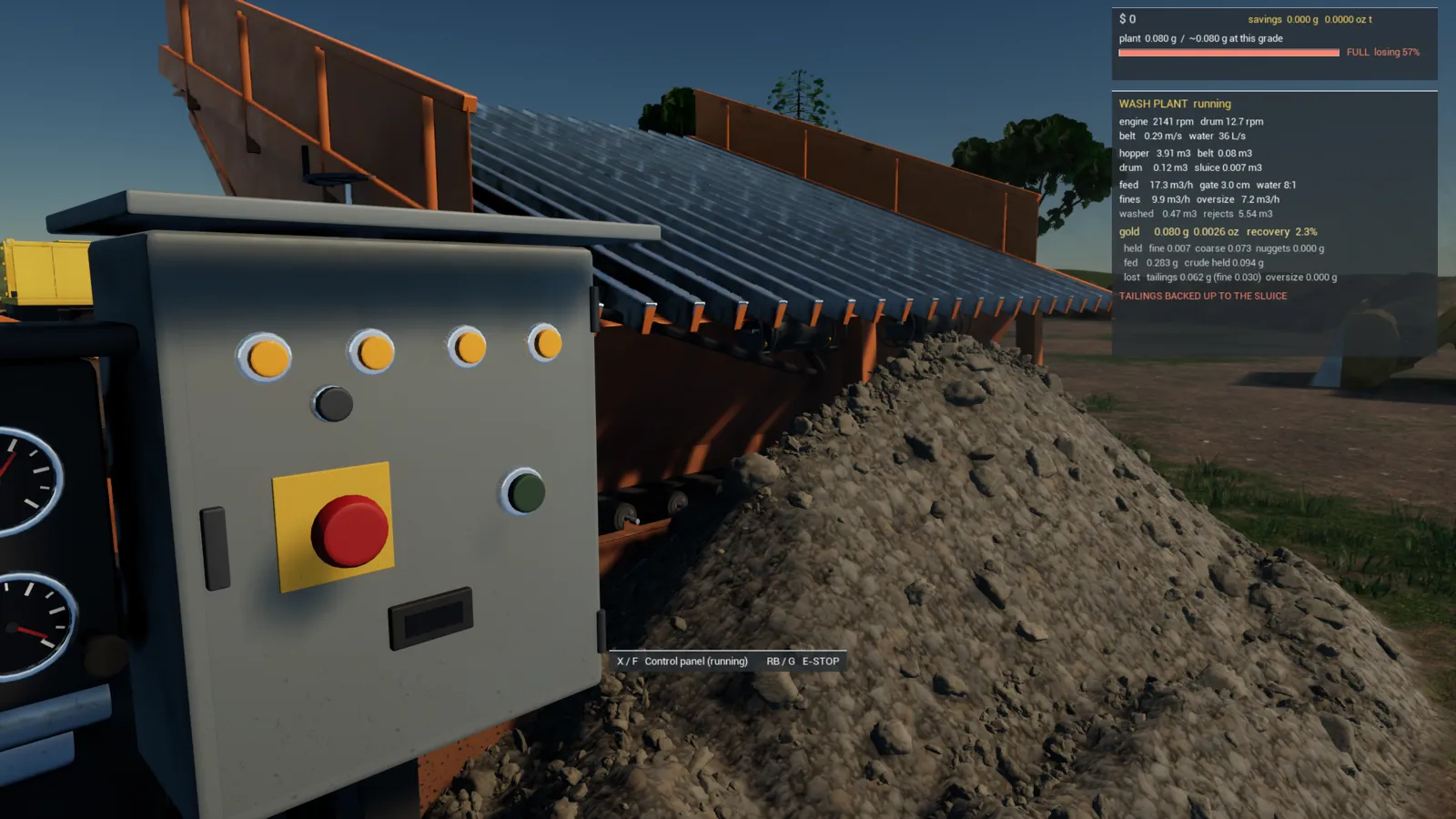
- Keep the hopper fed, never heaped to the bars. The belt draws a steady 46 m³/h of gravel while the slot is covered. Once the dirt in the hopper stands within 18 cm of the grizzly bars, whatever you tip next rides off the grizzly with the rejects, gold and all. A loader bucket every four or five minutes, or a 20 t excavator bucket every minute and a half, keeps it right.
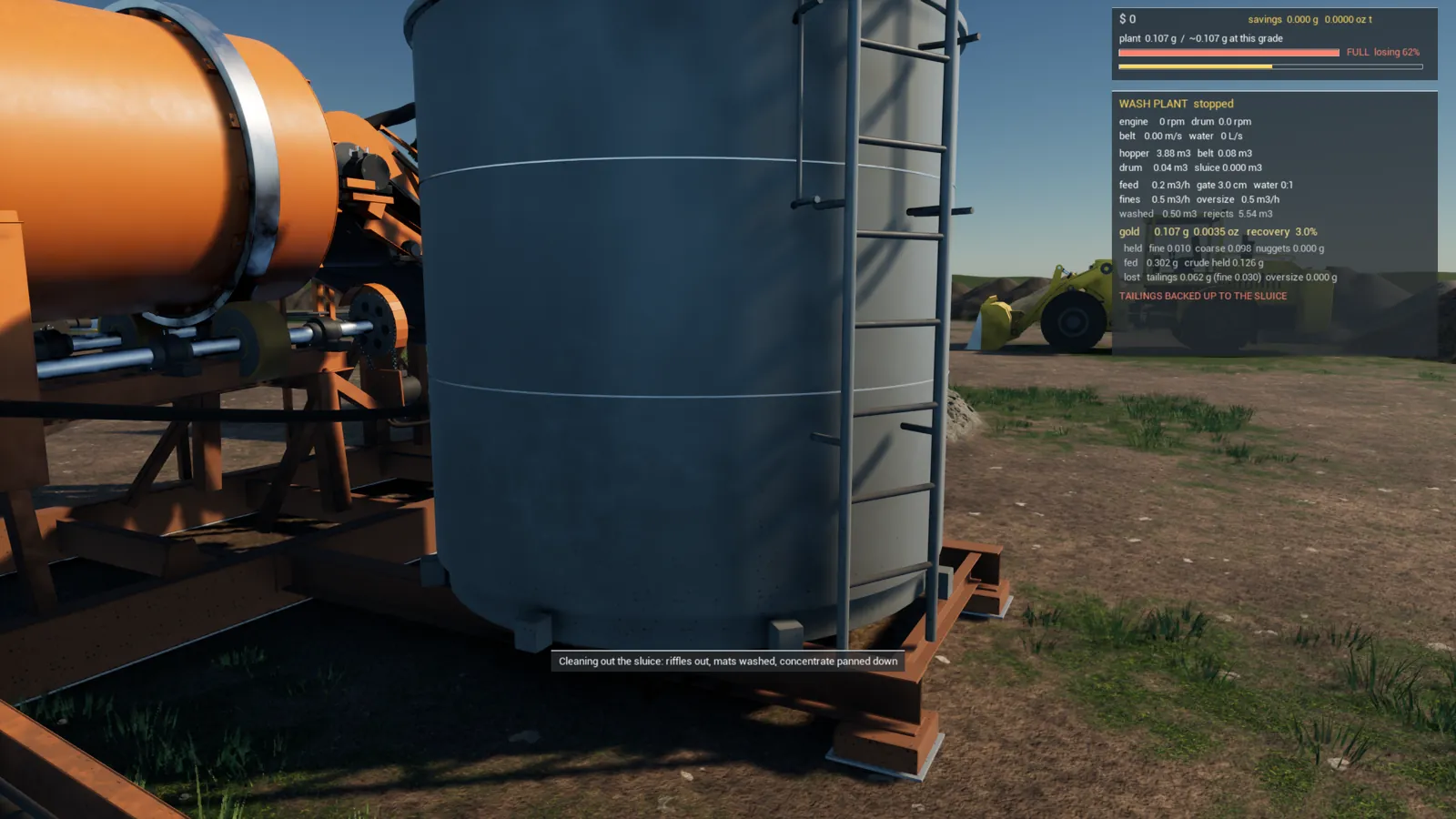
- Clean out at about 50% on the riffle bar at the top right of the screen: roughly every 45 minutes of steady gravel. See Cleaning out a wash plant.
- Stop with STOP, not the E-stop, so the sluice runs clear on its water.
| Run like this | Fine gold held | Coarse gold held |
|---|---|---|
| Gravel, riffles clean | 55% | 99% |
| Sandy ground | 49% | 99% |
| Riffles half full | 37% | 94% |
| Riffles full (bar red, FULL) | 11% | 51% |
Clay: the drum's spray bars and tumbling break clay down and free the gold locked in it. On ground with a third clay, about 2% of the gold still leaves with the oversize; on pure clay about 7%.
Reading the board: its water N:1 counts the whole feed, oversize included. The sluice itself sees more water than that (7:1 on the board is about 12:1 on the sluice for gravel). It turns red under 4:1.
The 250 tph screen plant
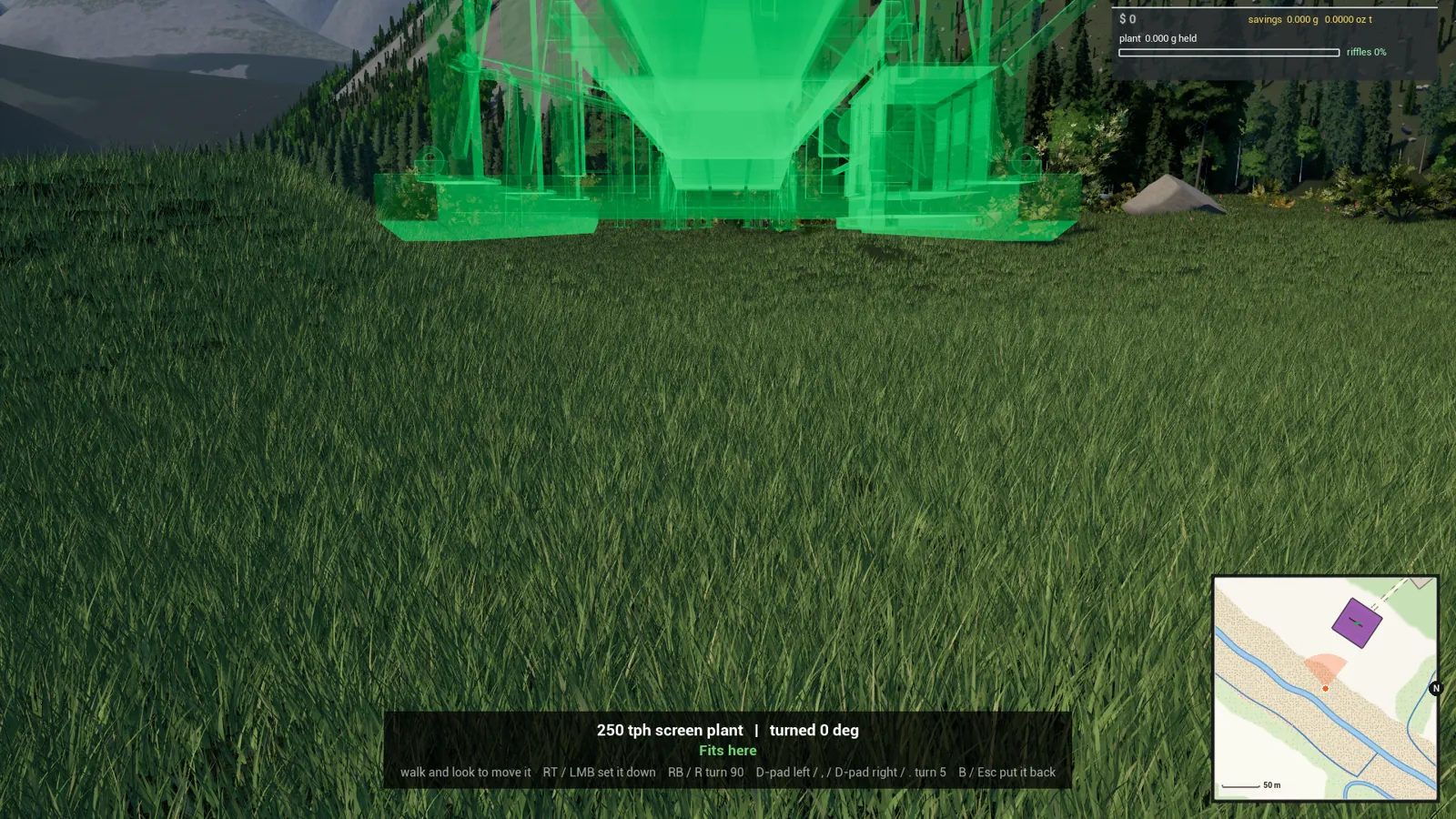
The big plant, with three sluice runs (one coarse, two fine), each 7.3 m long with 32 riffles. Rated 250 t/h; its pump gives 180 l/s when the water is close enough below it. It's a demo plant: get it from DEMO VEHICLES in the pause menu (see Moving and placing the 250 tph wash plant).
- Get the water right first. The pump gives its full 180 l/s only when the water is no more than 3 m below the pump. Every metre more costs a fifth of the flow, and from 7 m it can't draw at all. A 5 m lift cuts the fine gold held from 54% to 29%. The suction reaches a water tank within about 22 m, or the deepest water at least 40 cm deep within about 21 m.
- Set the gate by the fine runs. At the panel, hold D-pad up (R) to open the feed gate and D-pad down (T) to close it. Keep the two fine runs at 8:1 or better. The board says a run wants 6:1 to 10:1; the riffles only catch fully from 8:1, so aim for the top of that range.
- Don't chase the coarse run. It goes red at the rated 250 t/h of gravel, but only about 5% of the dust gold goes down it.
- Close the gate on sandy ground. Sand all goes through the screen to the fine runs, which drown above about 100 t/h of it.
- Clean out at about 45% on the runs' riffle readings, about every 50 minutes at 250 t/h. The FULL warning never shows on this plant: its riffle readings top out at 94%, so don't wait for it.
| Run like this | Fine gold held | Coarse gold held |
|---|---|---|
| 110 t/h gravel, full water | 56% | 99% |
| 250 t/h gravel (rated), full water | 54% | 98% |
| 500 t/h gravel (twice rated) | 38% | 80% |
| 250 t/h, pump lifting 5 m | 29% | 85% |
| 250 t/h, half the water | 19% | 71% |
| 250 t/h of sand | 17% | 65% |
| 250 t/h, riffles half full | 36% | 92% |
When a run is short of water, the board tells you why: THE PUMP GIVES X OF Y L/S: IT LIFTS X M means move the water closer below the pump; PUMP AT FULL FLOW: TOO MUCH FEED means close the gate.
The small power sluice and 3 in trash pump
Towed by the pickup and fed by a loader or a small excavator (both demo vehicles). It washes about 14 t/h of gravel well; the pump gives 19 l/s and can lift its water 7.6 m at most; the sluice is 0.6 x 3.6 m with 34 riffles.
- Keep the dirt at the hopper's throat shallow. The spray washes out as much dirt as the throat gives it. With no more than about 12 cm of dirt standing at the throat, the sluice holds 56% of the fine gold; with the throat buried, 22%. About one 8 t excavator bucket every two minutes.
- Set it down on ground flatter than 12 degrees. Steeper, and it takes no water at all. Hitched to the pickup it takes none either.
- Pump close to its water. Its suction end within 5 m of water at least 15 cm deep (or of a water tank), and the lay-flat hose to the sluice no longer than 20 m.
- Clean out at about 45%. Its riffle reading tops out at 88%, which means full.
| Run like this | Fine gold held | Coarse gold held |
|---|---|---|
| Throat 12 cm or less, riffles clean | 56% | 99% |
| Throat 24 cm (twice the feed) | 24% | 81% |
| Throat buried (hopper kept full) | 22% | 78% |
| Pump at half flow | 34% | 92% |
| Riffles half full | 38% | 95% |
Clay lumps bigger than its 5 cm bars ride off the back with their gold: it's a gravel machine.
The mini power sluice
For testing ground by hand: a 14 litre header, a 1.1 kW pump giving about 2 l/s, and a 1.8 m box with 37 riffles.
- Keep the header nearly empty: under about a fifth full on its header % reading. Run like that, it holds 55% of the fine gold; with the header a quarter full or more, 39%.
- The intake wants 9 cm of water to go in, and at least 5 cm over the strainer while it runs.
- The slope setting doesn't change recovery. Set whatever is comfortable.
- Clean up at about 40%. Its riffle reading tops out at 78%, which means full.
- Use it to test ground. Its reading "fed N l at X g/m3" is the only grade figure on screen in the game: a few shovels from a bench tell you whether the big plant is worth bringing in.
Re-run your tailings
Everything a plant throws out goes back into the ground with its gold: tailings, oversize, grizzly rejects, and the 1.5% lost at each clean-out. Dig it again and you get the same share of its gold as the share of its dirt you dig. Even run perfectly, a plant sends almost half the fine gold out with the tailings, so a second pass is worth it.
You can also catch the tailings as they come off: a truck, a feed hopper or a conveyor section's loading box set under the end of the sluice takes them instead of the ground.
Quick reference
Reading the riffle gauge
The riffles % on three of the plants never reaches 100%: a few riffles on each sit where the run never drops sand behind them. Go by this, not by the warning:
| Plant | Reads when full | Clean out at | Roughly every |
|---|---|---|---|
| Trommel plant | 100% | about 50% | 45 min of gravel |
| 250 tph screen plant | 94% | about 45% | 50 min at 250 t/h |
| Small power sluice | 88% | about 45% | 1.5 h at 14 t/h |
| Mini power sluice | 78% | about 40% | about 2.5 m³ shovelled |
When you see...
| You see | Do this |
|---|---|
| Screen plant run line red, TOO LITTLE | Read the next line: it says whether it's the pump or the feed. Too much feed: close the gate. |
| THE PUMP GIVES X OF Y L/S: IT LIFTS X M | Move the plant or its tank so the water is no more than 3 m below the pump. |
| NO WATER on the trommel | Water tank within 15 m of the plant's inlet, standing level. |
| Small sluice not washing | Is it set down flatter than 12 degrees? Pump within 5 m of water 15 cm deep, lay-flat 20 m or less? |
| Riffle bar amber or red, FULL losing N% | Stop and clean out. Next time clean at half. |
| HOPPER RUNNING OVER THE RIM, or dirt riding off the grizzly | Feed slower. That dirt leaves with its gold. |
| Recovery low with clean riffles and full water | Sandy or clay ground. On sand, feed slower. On clay, use the trommel: it scrubs clay. |
Figures are worked from the game's own rules (unchanged from 0.3.82 to 0.3.86) for a plant fed gravel unless stated: the share of the gold reaching the sluice that stays in the riffles. Your ground's gold split, its clay and sand, and how evenly you feed all move them.